
Case study · Cornelsen
Launching UMA Plus. A journey into digital education.
Image: ChatGPT
Executive brief
The challenge
- 4 months to prepare a UMA Plus demo for Didacta, Germany's largest education fair.
- 9 months until the next school-year sales and licensing cycle.
- Define where teachers and learners could access UMA Plus while the new learning platform was still in development.
My role
- UX Team Lead for Cornelsen.de, Cornelsen's eCommerce experience
- Developed a user-centred rollout strategy from demo to full release.
- Mapped the end-to-end customer journey to align stakeholders and identify critical moments.
The shift
- Guided UX improvements from product discovery to daily classroom use.
- Turned a phased launch challenge into a managed end-to-end customer journey.
- Supported the retirement of an obsolete platform, reducing operating costs.
- Simplified the teacher experience across Cornelsen's digital products.
01 · Overview & starting point
Launching a new digital teaching experience: UMA Plus
 (opens enlarged image)
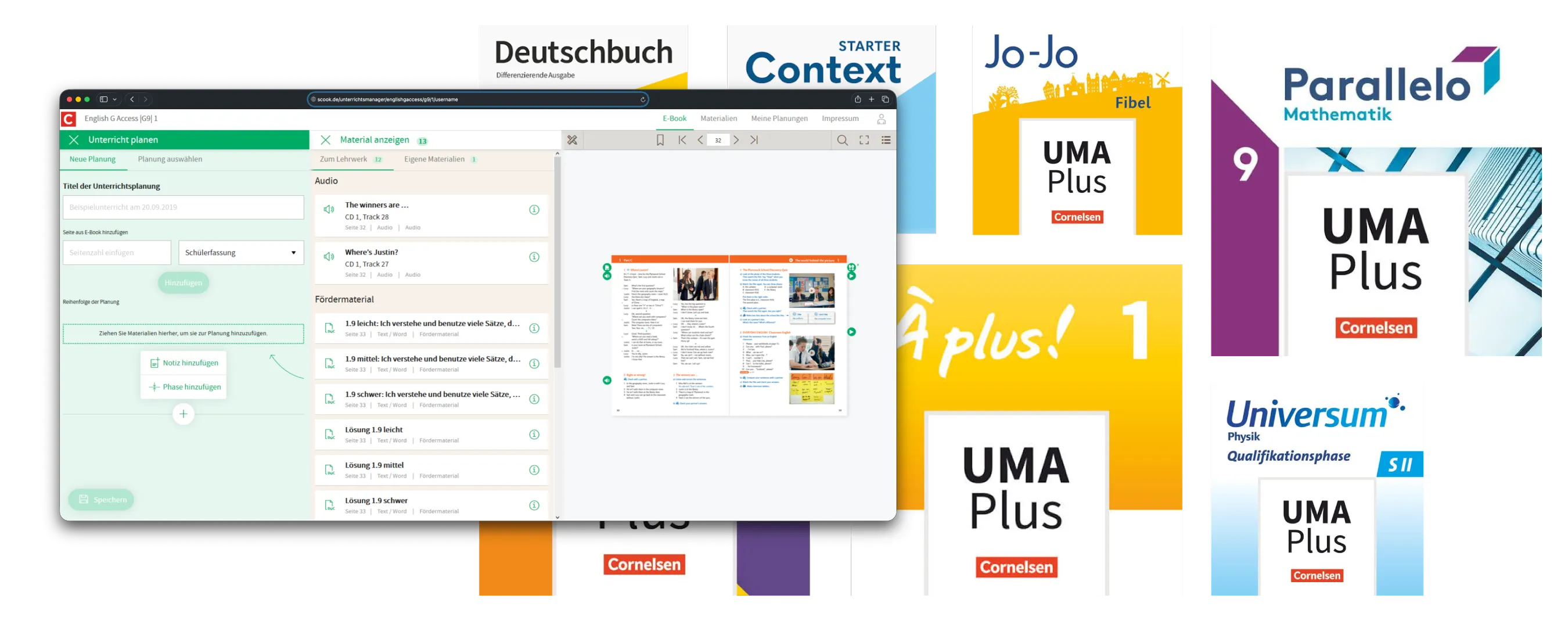
In 2020, Cornelsen prepared to launch UMA Plus—the next generation of its most important digital teaching and learning product. Built around Cornelsen’s schoolbooks, it combined digital editions for teachers and students with additional materials and tools for planning, presenting and delivering lessons.
UMA Plus was designed to support a wide range of subjects and many of Cornelsen’s best-known schoolbook programmes within one digital experience.
02 · Understand · The timeline(s)
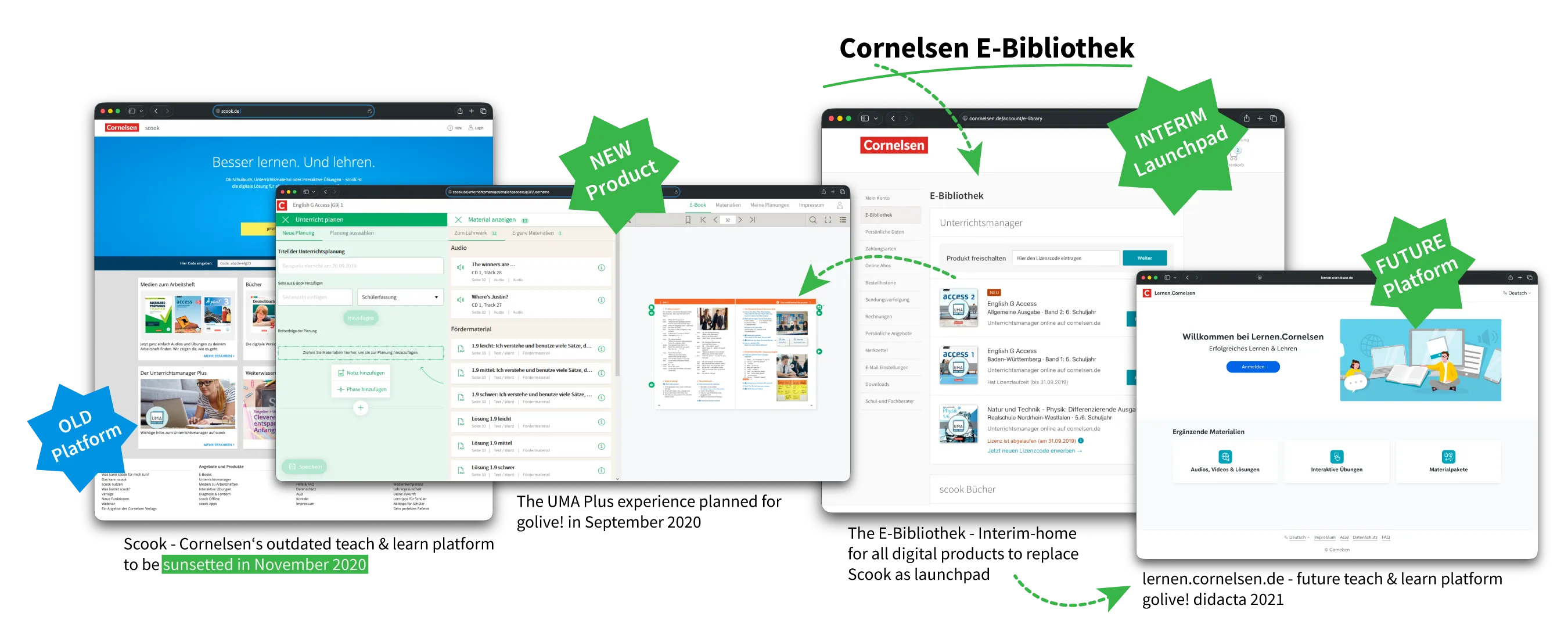
Introducing the E-Bibliothek, a new place to launch digital products
 (opens enlarged image)
Didacta, Germany’s leading education fair, set a fixed deadline to introduce UMA Plus before purchasing decisions for the next school year. But the product would not be ready in time, while Cornelsen’s existing learning platform, Scook, was being retired and its successor was still in development. The E-Bibliothek inside Cornelsen.de therefore had to become the temporary launchpad for UMA Plus, eBooks and interactive lessons.
This transition created a fragmented journey across marketing, eCommerce, licensing and classroom use, with funnel data already showing significant customer drop-offs. To create a shared view of these barriers and align teams around the experience, I initiated a customer-journey programme covering the complete path into Cornelsen’s digital education ecosystem.
03 · Understand · The legacy journey
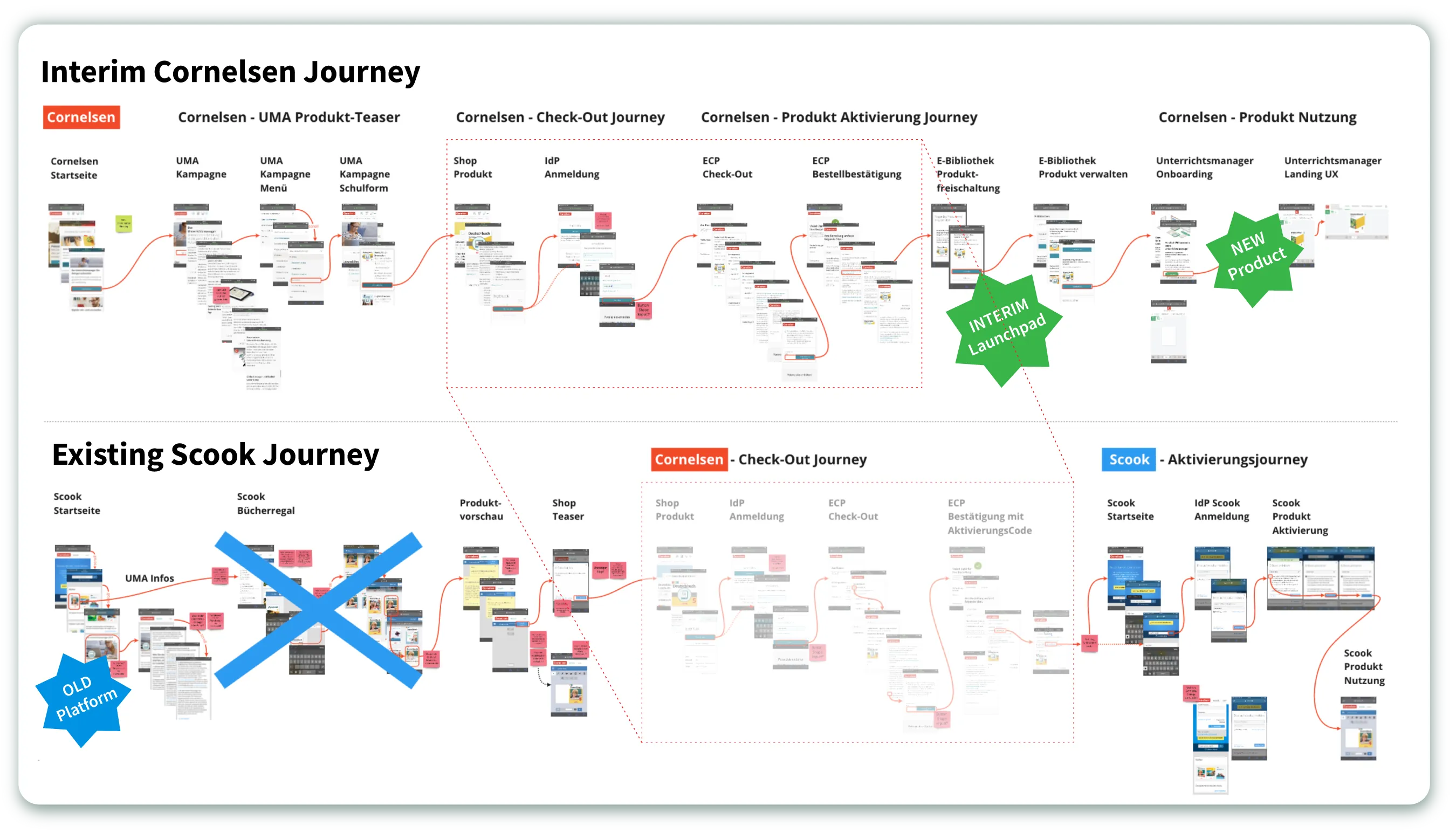
Two overlapping journeys had evolved around one product
 (opens enlarged image)
Mapping every screen and handover revealed two overlapping journeys: the established route through Scook and the emerging route through Cornelsen.de and its E-Bibliothek.
What appeared to be one product journey crossed marketing pages, product catalog structures, accounts, checkout systems, licence activation and two platforms. Making the entire experience visible gave teams a shared first view of its scale—and provided the basis for a more focused analysis.
04 · Understand · User and business needs
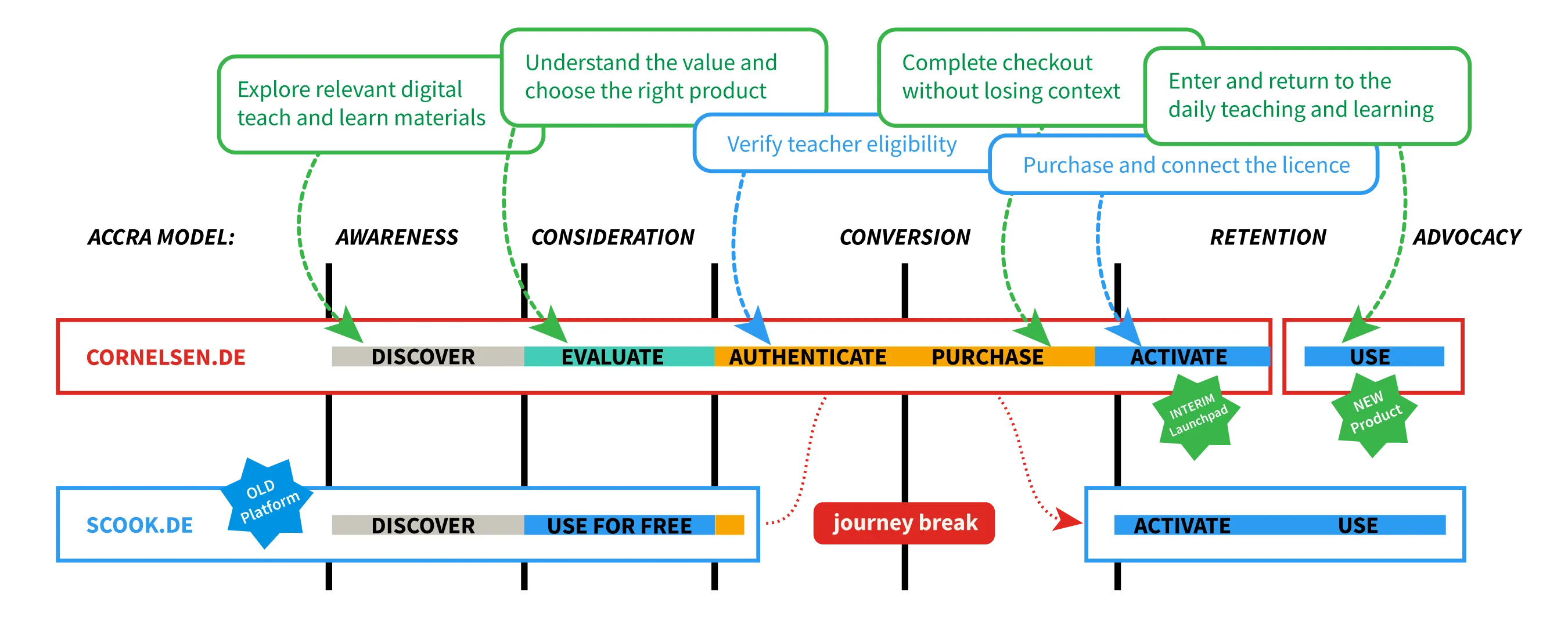
The journey is organised in phases of varying user and business needs
 (opens enlarged image)
To make the complexity actionable, I reorganised the journey around what customers and Cornelsen as an eCommerce experience are trying to achieve in the typical journey phases—from discovering the UMA product to using it in the classroom on a daily basis.
Applying the ACCRA journey model, a standard structure to organise user needs and business objectives, Cornelsen’s specific journey phases started to become visible. These phases became the foundation of the next steps in the process to learn more about how good the experience actually was.
05 · Understand · The experience status quo
Deep dive in Cornelsen's journey into digital education
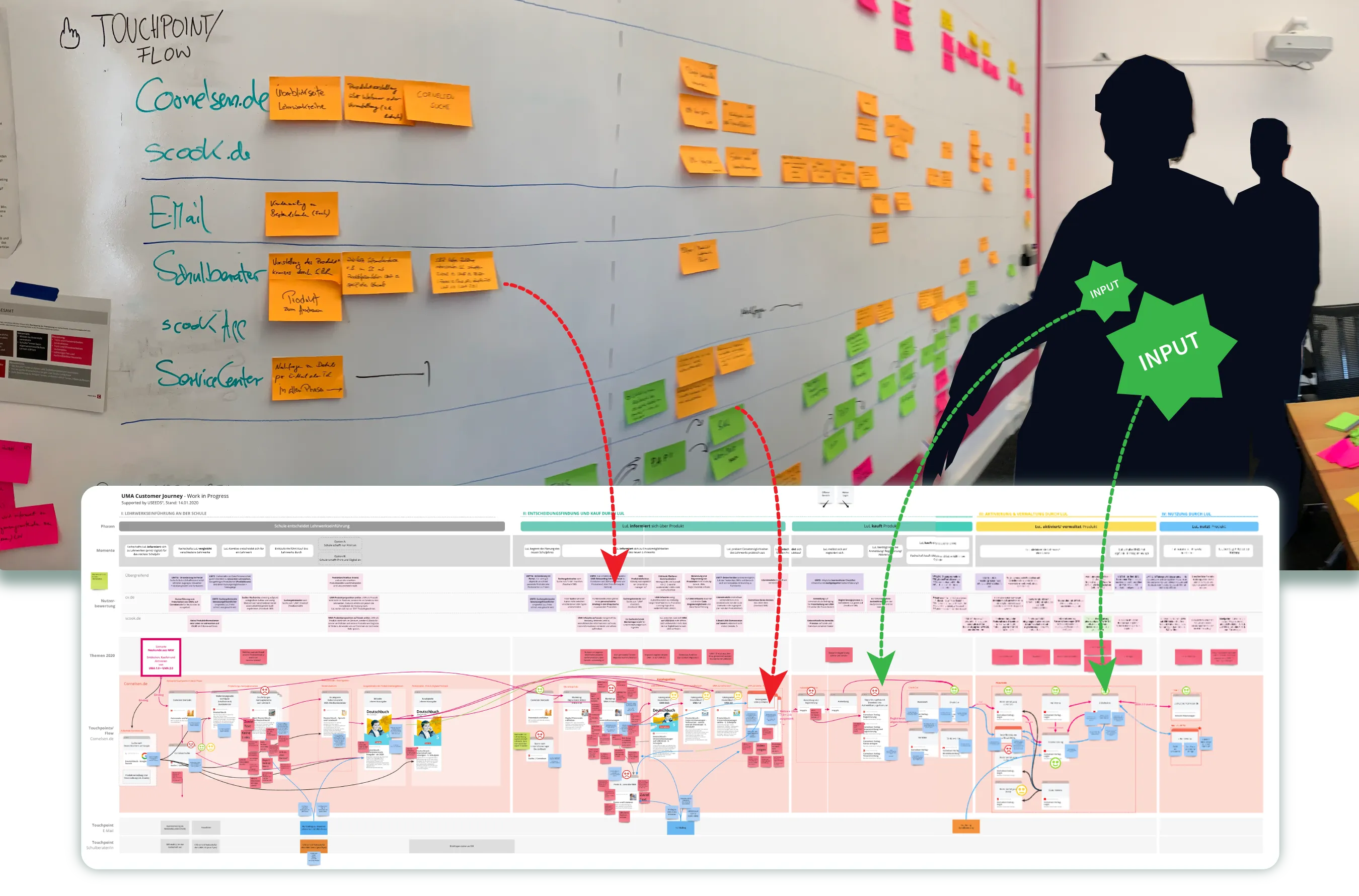 (opens enlarged image)
From workshop input to shared journey: Together with Useeds and stakeholders across the organisation, we consolidated customer feedback, research and operational knowledge into one end-to-end view. This view - Cornelsen’s digital customer journey - was full of problem zones… many more than we had originally anticipated.
06 · Define the problem zone
Evidence clusters revealed the broken key moments that mattered most
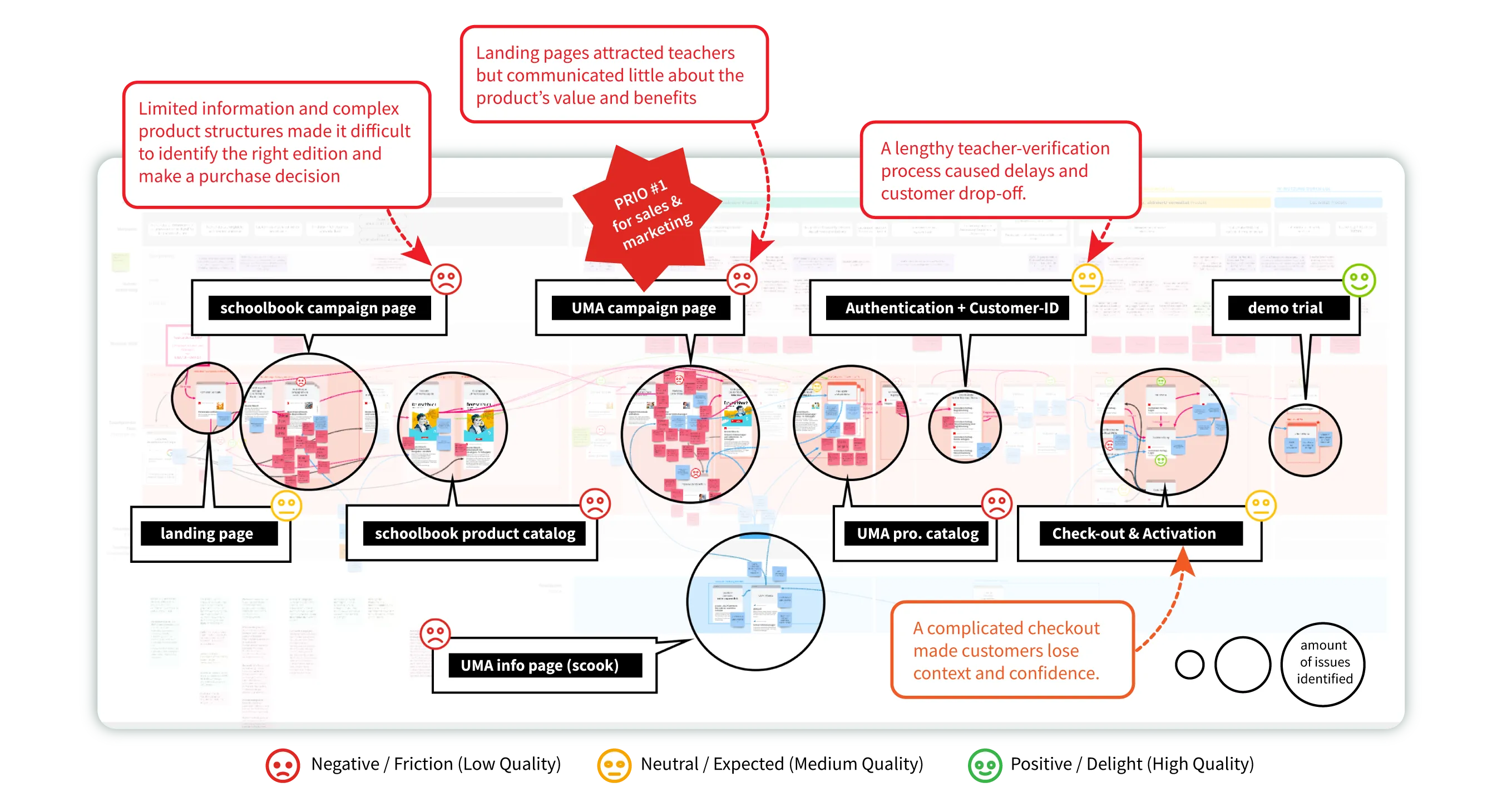 (opens enlarged image)
From findings to focus: Clusters of research evidence revealed where the journey created critical friction, where existing experiences already worked well and informed conversations where we should focus on first, then next and then next after.
The most significant barriers appeared at the handovers between journey phases: from marketing to product information, from evaluation to authentication, from purchase to activation and from eCommerce to classroom use.
To start unblocking the journey, we agreed with our colleagues from Marketing and the eCommerce product team, to dive deeper into the UMA Plus campaign page and make this our first priority for improvement ideation, integrated into the step-by-step release planning of the brand new UMA Plus.
07 · Operationalize the journey
From journey map to shared release plan
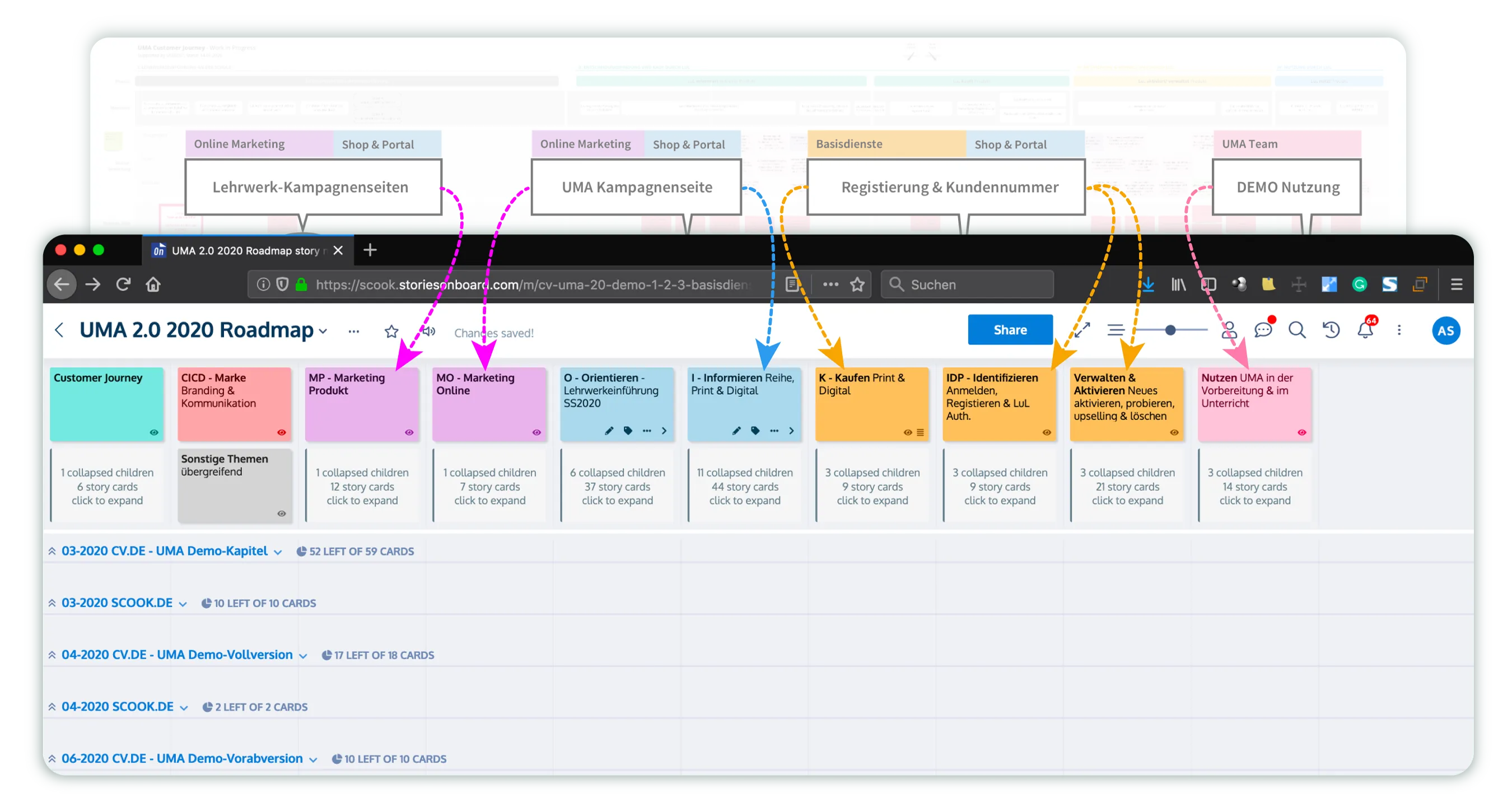 (opens enlarged image)
Once the key moments and dependencies were understood, we transferred the identified work into StoriesOnBoard. Its story-map structure allowed us to organise tasks by journey phase and release while connecting the work with Jira and Confluence. This was important because each release required coordinated changes across multiple touchpoints—from campaign pages and product catalogues to authentication, checkout and licence activation.
I loved to work with StoriesOnBoard when sitting with stakeholders in bi-weekly release coordination meet ups. I just could expand the view for each release, walk through and review the action items for each journey moment which needed attention, clarification, improvement or a team’s specific contribution.
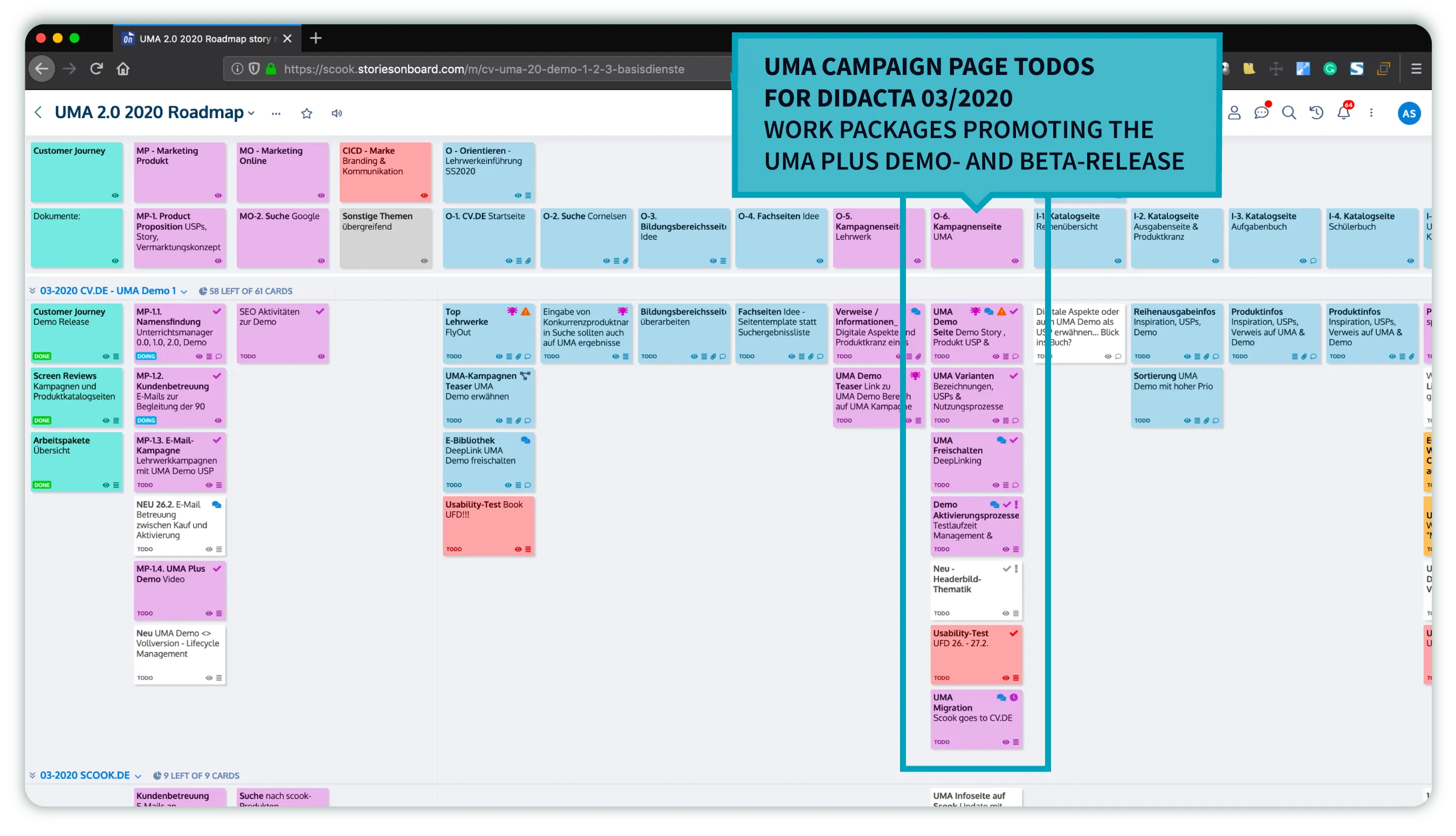 (opens enlarged image)
This shared roadmap made these dependencies manageable and accessible to stakeholders beyond the product and engineering teams. Most importantly, it preserved the end-to-end customer journey overview, while individual teams had transparency about their respective contributions.
08 · Understand · Digital value propositions
Reframing the UMA Plus value proposition narrative
The UMA campaign page emerged as one of the journey’s first critical key moments. Analytics showed that many visitors left without continuing towards purchase.
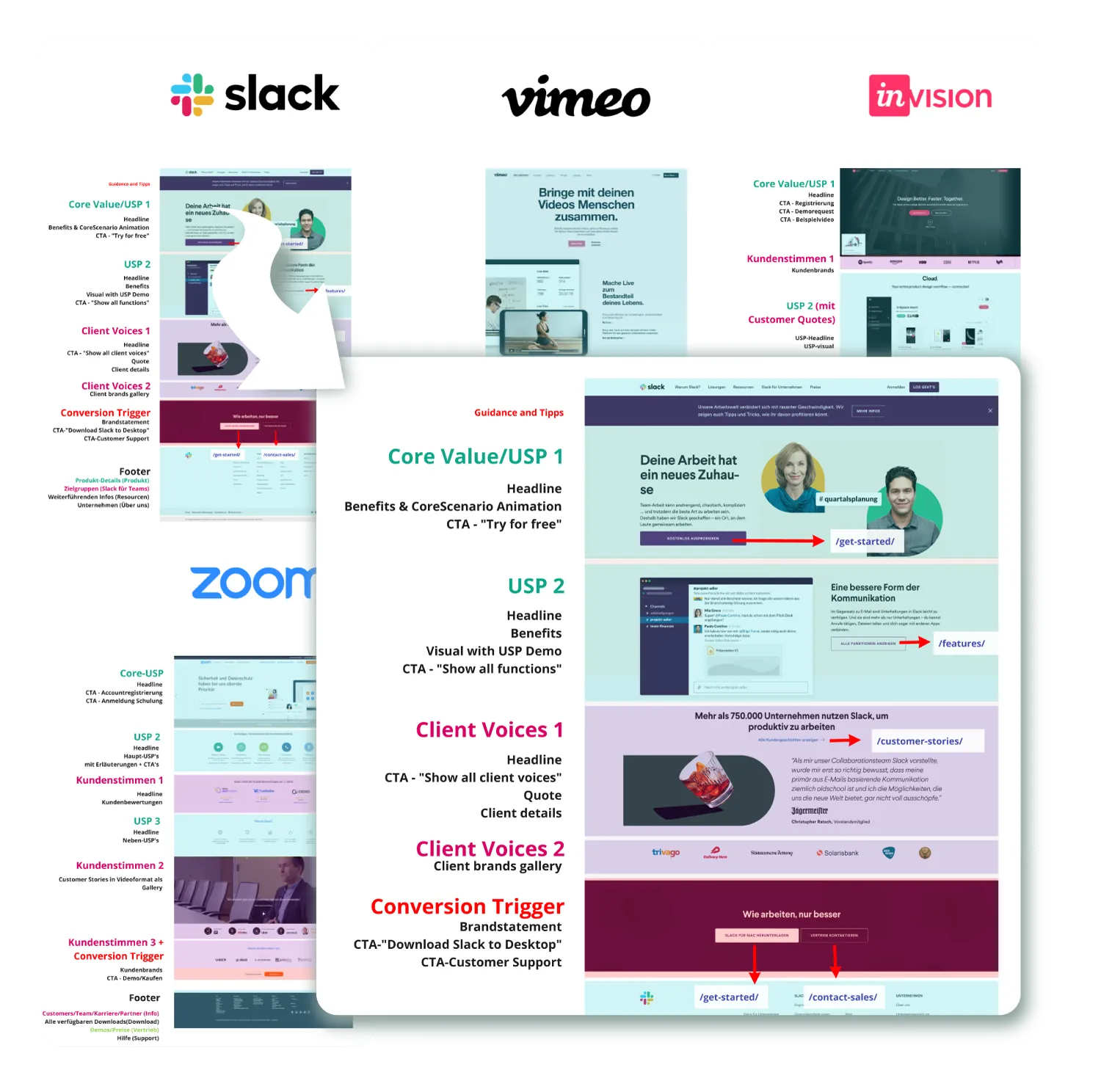
Learning from digital product storytelling
 (opens enlarged image)
Together with Marketing, Sales and Product Management, I reviewed the experience and identified two connected problems: the communication followed conventions developed for printed products, while the available page templates and UI components made it difficult to explain the value of a digital service.
In workshops, we analysed how services such as Slack, Zoom, InVision and Vimeo structured their stories around customer benefits, product evidence, social proof and conversion triggers. Their continuously evolving pages also demonstrated that value propositions should be tested and refined—not treated as static campaign assets.
Connecting the proposition to user needs
 (opens enlarged image)
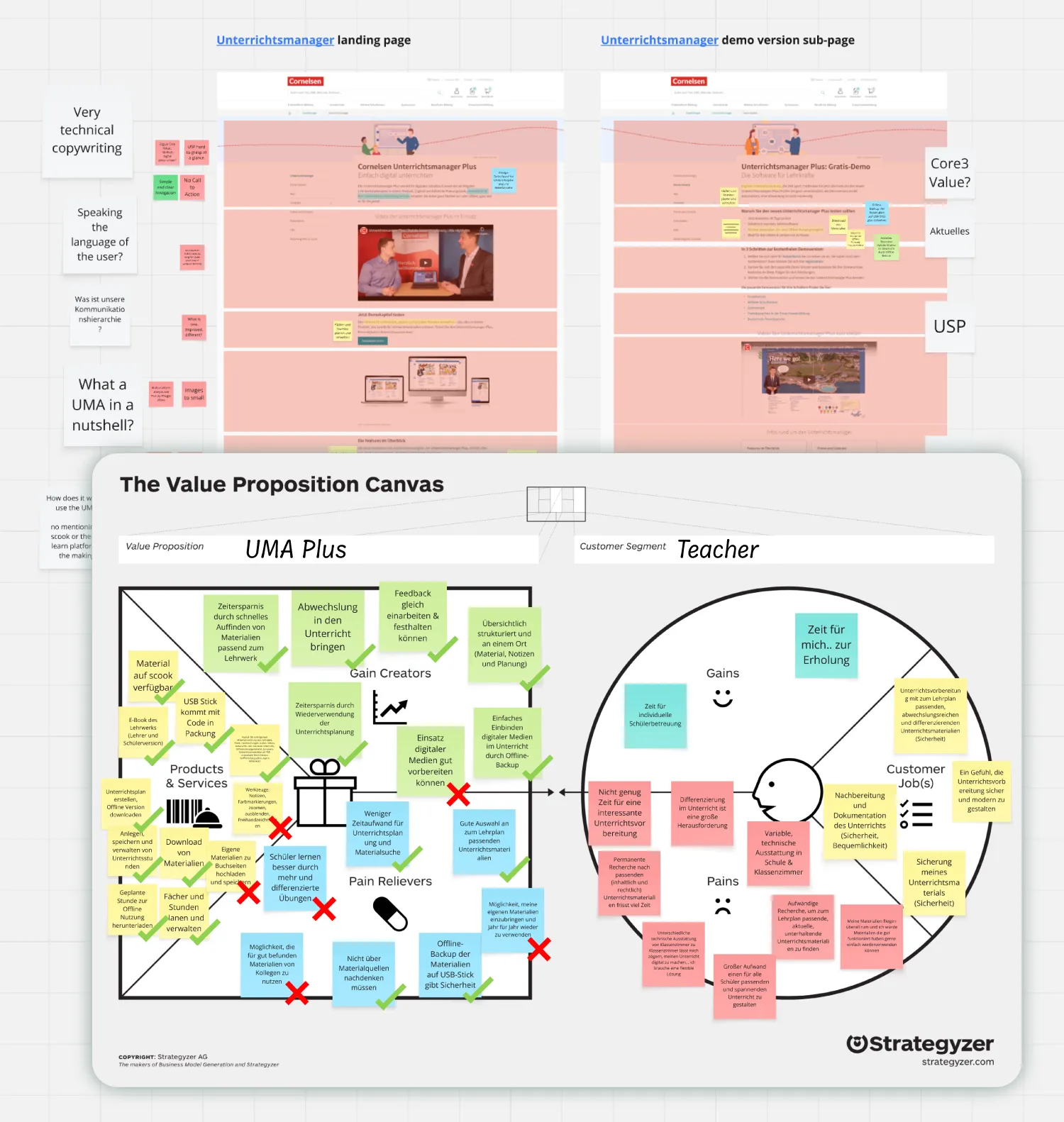
Benchmarking showed us how digital services communicated value, but not which message would resonate with Cornelsen’s customers.
Using Strategyzer’s Value Proposition Canvas, I facilitated the collaborative mapping of needs, pains and desired gains of teachers, students and parents. In the workshop with Marketing we then assessed Cornelsen’s existing copy, visuals and storylines against those user motivations and drivers.
This exposed where the campaign described product features without connecting them clearly to classroom challenges or meaningful customer benefits. The analysis gave Marketing, Product and UX a shared foundation for reframing the UMA Plus story around the value it created for its users.
09 · Ideate · Test · Learn & iterate
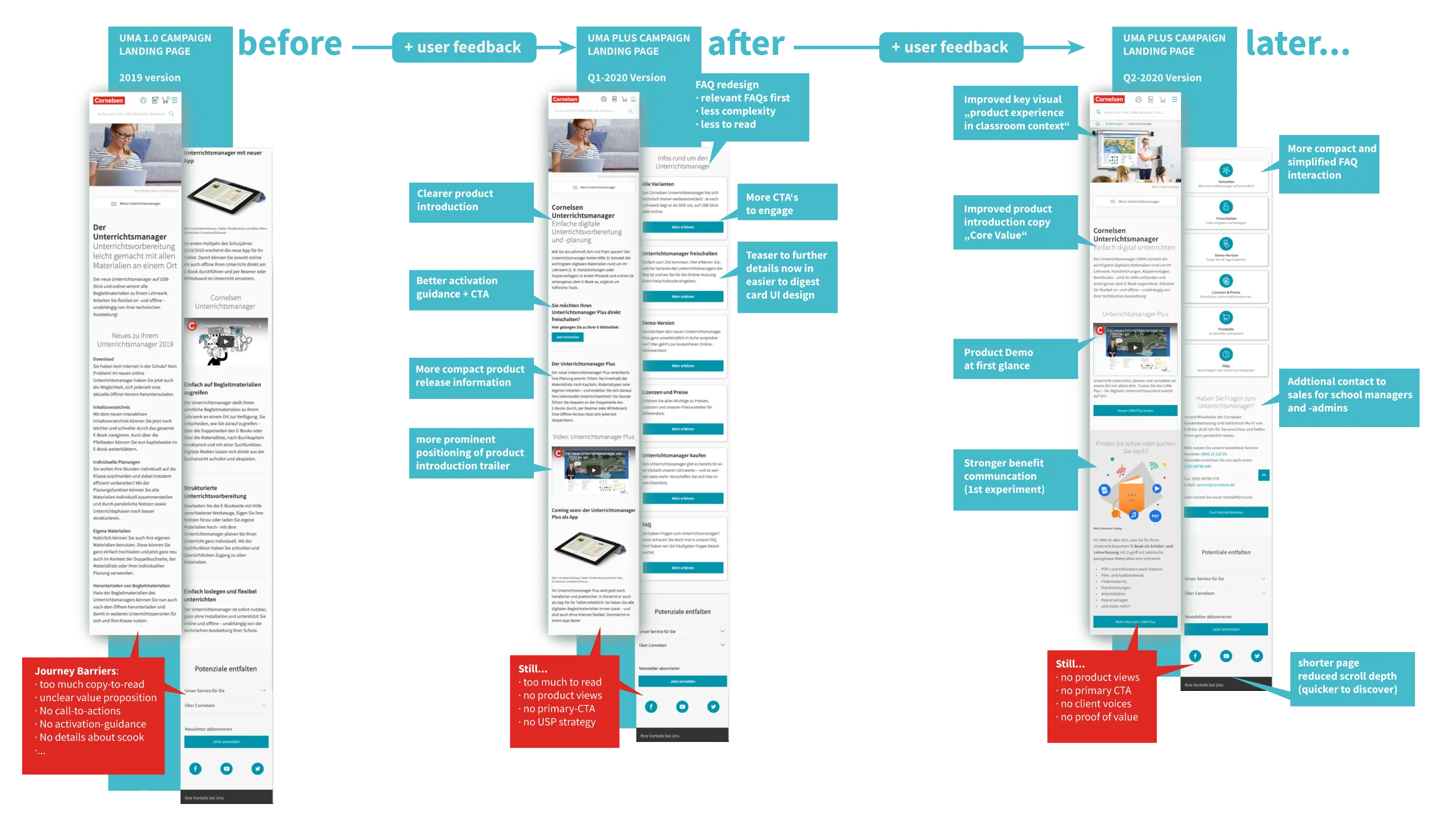
From static campaign page to evolving product story
 (opens enlarged image)
With the learnings made in the workshops, step-by-step a new way of working was established to improve the campaign page release after release.
Together, we refined the campaign templates, redesigned supporting UI components and developed new editorial content. Successive iterations introduced clearer product benefits, stronger calls to action, better activation guidance, better positioning of product demo trailer and a shorter, more focused page structure. User feedback helped us review and refine these changes throughout the UMA Plus rollouts in 2020 and 2021.
Beyond improving one campaign page, the collaboration established a new way of working: Combining value-proposition design, editorial and ui iterations together with user feedback within one iterative release process. This approach could then support other digital Cornelsen products and the continuing transition from Scook to lernen.cornelsen.de.
Check out the latest version of the UMA campaign page. I believe the team has improved the experience even further now, long after my departure from Cornelsen.
10 · Outcome & Reflection
Timely UMA Plus launches - and journey management as continuous practice
- The UMA Plus Demo became successfully made available, integrated and launched from the E-Bibliothek for interested users at Didacta 2020.
- UMA Plus campaign pages became improved with user feedback for better conversion
- Scook.de could become sunsetted in November 2020 - reducing bad user feedback and saving cost
- Customer journey management established as a new capability in Cornelsen's product organisation
- Further key moments became improved with user feedback later in 2020 and 2021: registration process for teachers and the schoolbook campaign pages
Reflection
As Cornelsen's digital products and a new teach&learn-platform evolved, so did the journeys guiding customers into their daily use.
The journey map became a living view of an experience shaped by many teams, systems and touchpoints. My role was to create recurring opportunities for these teams to review customer evidence, identify emerging friction and update the shared picture together.
This turned journey mapping from a one-off analysis into a cross-functional way of working.
Research and data created understanding, shared understanding enabled coordinated action—and repeated delivery helped embed the customer perspective across organisational boundaries.
Credits
Amelie Vernay, Sandra Sponagel, Thomas Viehweger, Christoph Steinlehner, Alexandra John, Denis Nikolai, Miriam Juli, Bianca Riedel, Stephan Otterbach, Claudia Maasmann and our research partner Useeds.